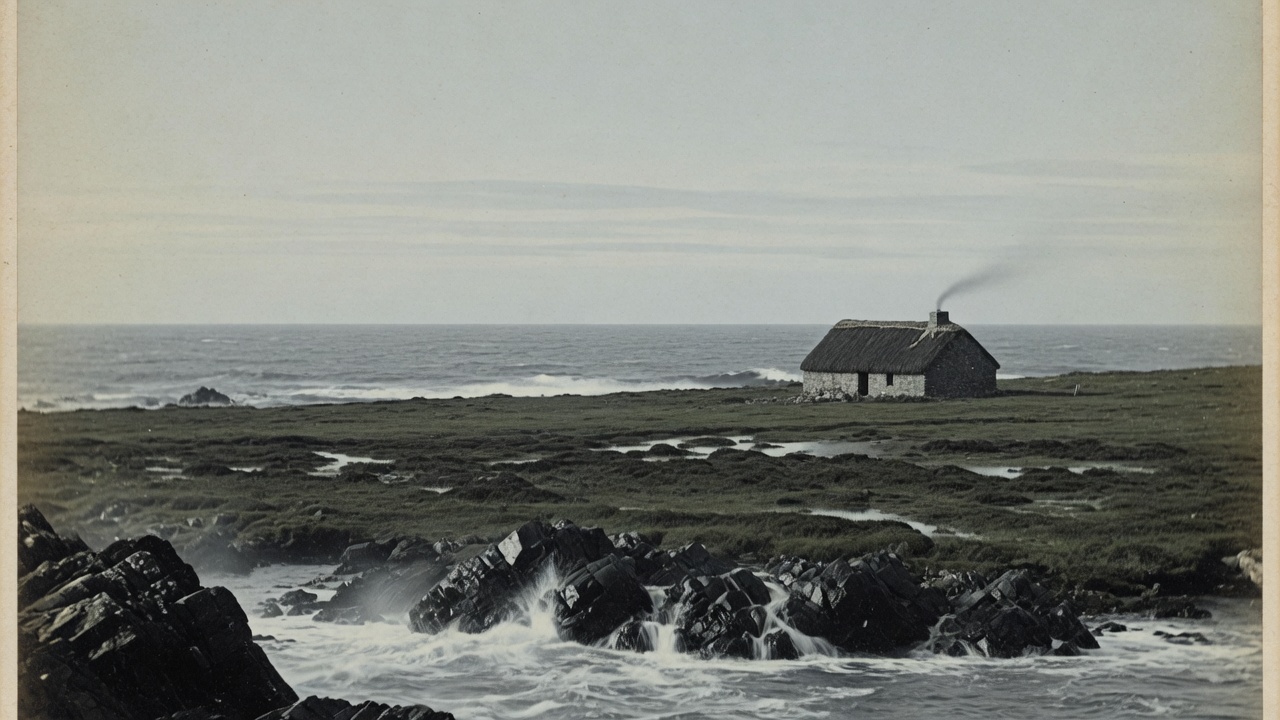
A family-history narrative for Patience, Daniel, and Faith Cheesman — the children in whom the islands finally come ashore.
PrologueThe crossing of the water
Lewis · South Uist · Moray → Saskatchewan → Alberta · c. 1832 to today
The Outer Hebrides had a phrase for the hardest journey of all — not a walk to the next township or a row across a sea-loch for peat, but the journey from which there is usually no return: a’ dol thar a’ chuain, the crossing of the water. When an island family said it in the 1880s, they meant that a son, a daughter, or a whole household was about to climb into the dark of a steerage hold and trade the only world they had known (the byre, the burn, the headstones of every grandparent back to the edge of memory) for a rumour of land on the far side of an ocean.
This is the story of three families who made that crossing. They were islanders and Highlanders out of three different corners of the Gàidhealtachd — the Gaelic-speaking world — the Presbyterian moor of Lewis, the Catholic machair of South Uist, the Moray coast between — who under any ordinary turning of history would never have met. A man from the Lochs of Lewis had no reason to marry a woman from the machair of South Uist; a coastal Moray family had no obvious thread to either. Yet all three streams ran out of the islands in the same terrible decade, poured into the same few square miles of southeastern Saskatchewan, and there — against the grain of three centuries of Highland history — they joined.
They joined in a marriage that — if each kept the faith of their own island, which the records do not yet tell us — crossed one of the hardest lines in the Hebrides. Out of it came a son, a granddaughter, and a line that runs straight down the twentieth century and arrives — by way of Edmonton, Calgary, and at last Grande Prairie — at three children alive in Alberta today.
The Hebrideans had a word for the virtue this story is really about: buanseasmhachd. The dictionary says “steadfastness,” but the truest sense is the crofter’s — holding your ground when the ground itself is being pulled out from under you. It is what gets a family of a dozen children through a Saskatchewan winter in a house built of turf. These three families had it, and needed every grain. This is the record of where they spent it, and of what came through on the far side.
Chapter OneJames Alexander Campbell (1832–1920) and Catherine Cameron (b. c. 1844) — the southern isle, the Spey-mouth, and the long patience of the cleared
1832–1920 · South Uist & Moray → Wapella, Saskatchewan
We begin the documented line with the oldest person the records let us see plainly: James Alexander Campbell, born 1 November 1832 on South Uist. He is the children’s great-great-great-grandfather, and he lived eighty-seven years across two centuries and two continents.
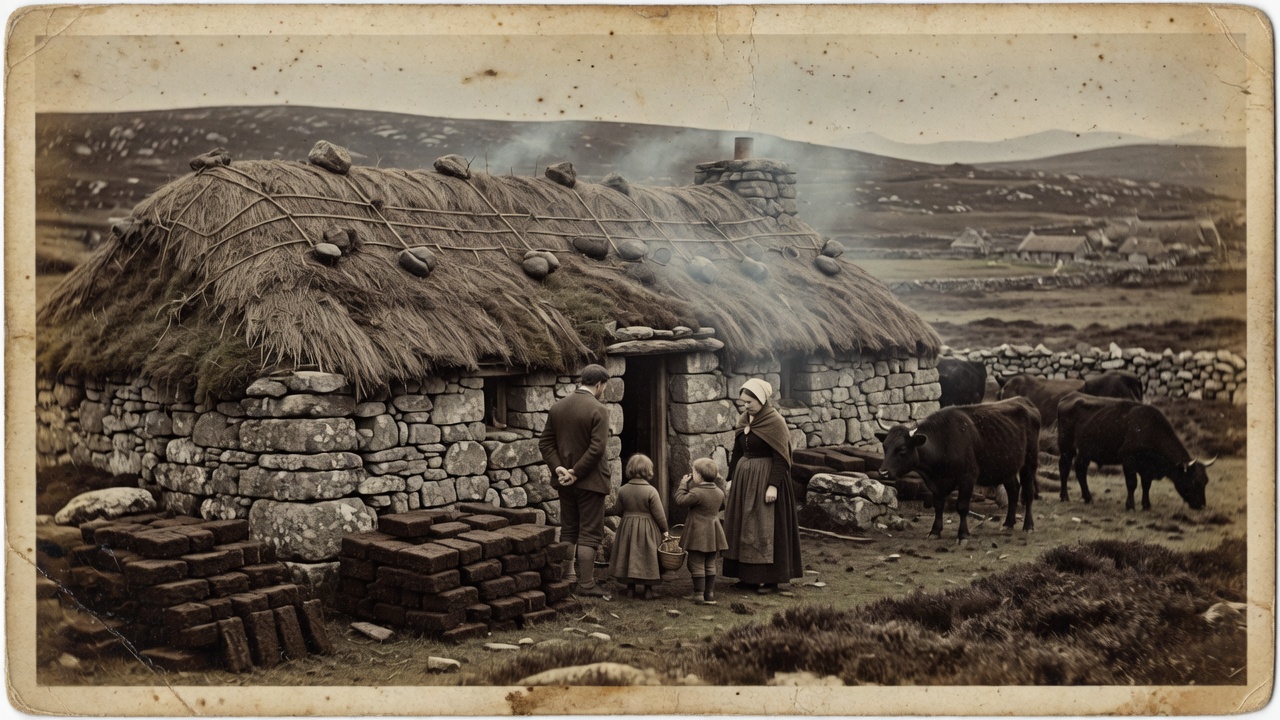
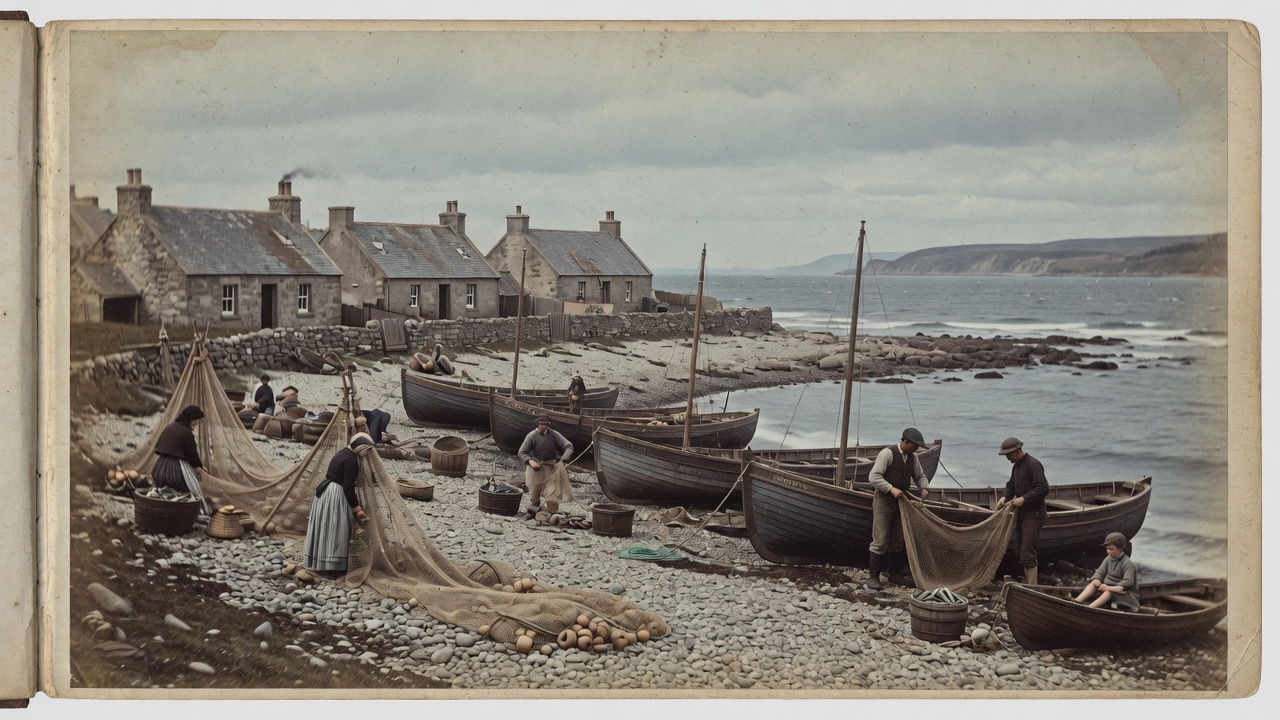
South Uist in 1832 was a place apart even within the Hebrides. Most of the Outer Isles had gone fiercely Protestant; but South Uist, with Barra and parts of Benbecula, stayed Catholic through the whole Reformation — an island of the old faith ringed by the new. To be a Campbell of South Uist was to be a Gaelic-speaking Catholic crofter on land owned by a Protestant aristocracy that increasingly regarded both your religion and your presence as inconvenient. The family’s likely townships are the low machair ground, Iochdar in the north or Dalibrog and Askernish toward the south — the shell-sand grassland that was the island’s one real treasure.
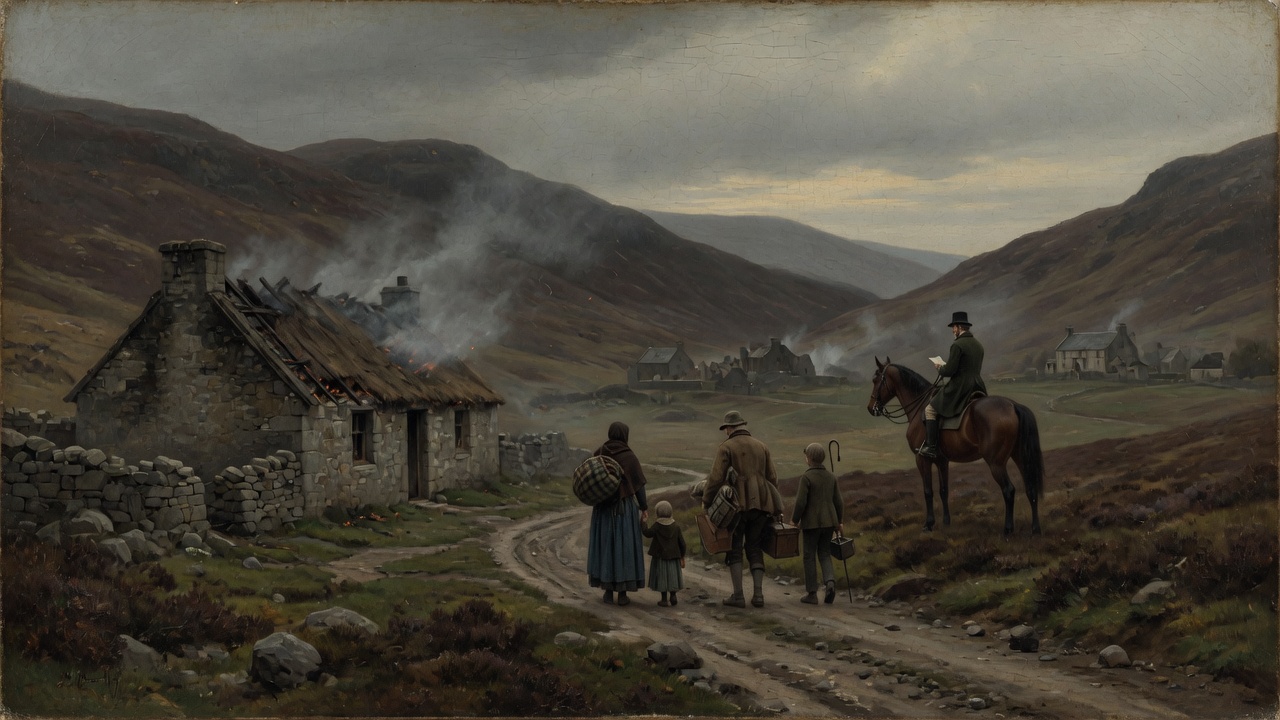
Behind that lies a catastrophe with a deceptively gentle name. Historians call it the Highland Clearances; the people who lived through it called it Fuadach nan Gàidheal — the driving-out of the Gaels. After Culloden in 1745 the state set out to break the clan system, and the chiefs turned from patriarchs into landlords: status once measured in fighting men was now measured in rent, and the most reliable rent came not from people but from sheep. Across roughly seventy years the people were cleared — sometimes with paper, rents raised past any crofter’s reach; sometimes with fire, the roof-timbers burned so the evicted could not creep back — and pushed onto coastal crofts deliberately made too small to live on. Learn more about the Highland Clearances →
Then, in 1846, the potato — the one crop the crofting poor could not do without — began to rot in the ground, as it was rotting in Ireland; the Highland Potato Famine was less murderous than the Irish one, but it ran failure after failure into the 1850s. Landlords facing starving tenants who could pay no rent reached the same conclusion: the cheapest thing was to ship these people somewhere else. “Assisted emigration” became a Highland industry — some went willingly, gambling everything on land of their own; some were marched aboard at the factor’s word, the Gaelic psalms rising off the decks.
James came of age through the worst of it: thirteen or fourteen when the potato failed in 1846, an adult in the famine decade under Colonel John Gordon of Cluny, who had bought South Uist, Benbecula, and Barra together and cleared tenants by the shipload; there are accounts from the early 1850s of families chased down and forced aboard emigrant vessels. James survived all of it, married a woman named Catherine Cameron, and stayed — for a while. What is remarkable is how long he held on: he was past fifty before he finally crossed the water, with a family grown half to adulthood around him. That is the buanseasmhachd of the man — he did not leave until staying had become impossible, and even then he left for the one thing the islands could never give a Catholic crofter: land of his own. James’s wife brings the third stream in from the east. Catherine Cameron was born, the family genealogy holds, around 1844 in the parish of Urquhart in Moray — not the famous Urquhart on Loch Ness, but the coastal parish near Spey Bay, where the Spey empties into the North Sea and the Gaelic Highlands shade into the Scots-speaking coast. Cameron is a Highland clan name, and it runs in three Alberta children because of her. She is, at this writing, a probable ancestor rather than a proven one: her birth, her Moray origin, and her marriage to James all come down through the family tree — consistent and plausible, but with the baptism that would confirm her not yet pulled from the parish register. We hold her name honestly and lightly. We follow them onto the ship in Chapter Two.
Chapter TwoDonald George McIver (1850–1932) — the man from the moor of Lewis, and how he got to Saskatchewan
1850–1932 · Lochs, Lewis → Saltcoats, Saskatchewan · immigrated 1883
Now the man whose surname the maternal line carries across the ocean: Donald George McIver, born 1850 in the parish of Lochs, Isle of Lewis. He was the son of Norman MacIver and Henrietta MacIver, born MacAulay — both Lewis people of the same moor. (McIver — in Gaelic MacÌomhair, “son of Ivor” — is one of the great surnames of Lewis, and Lochs one of its heartlands.)
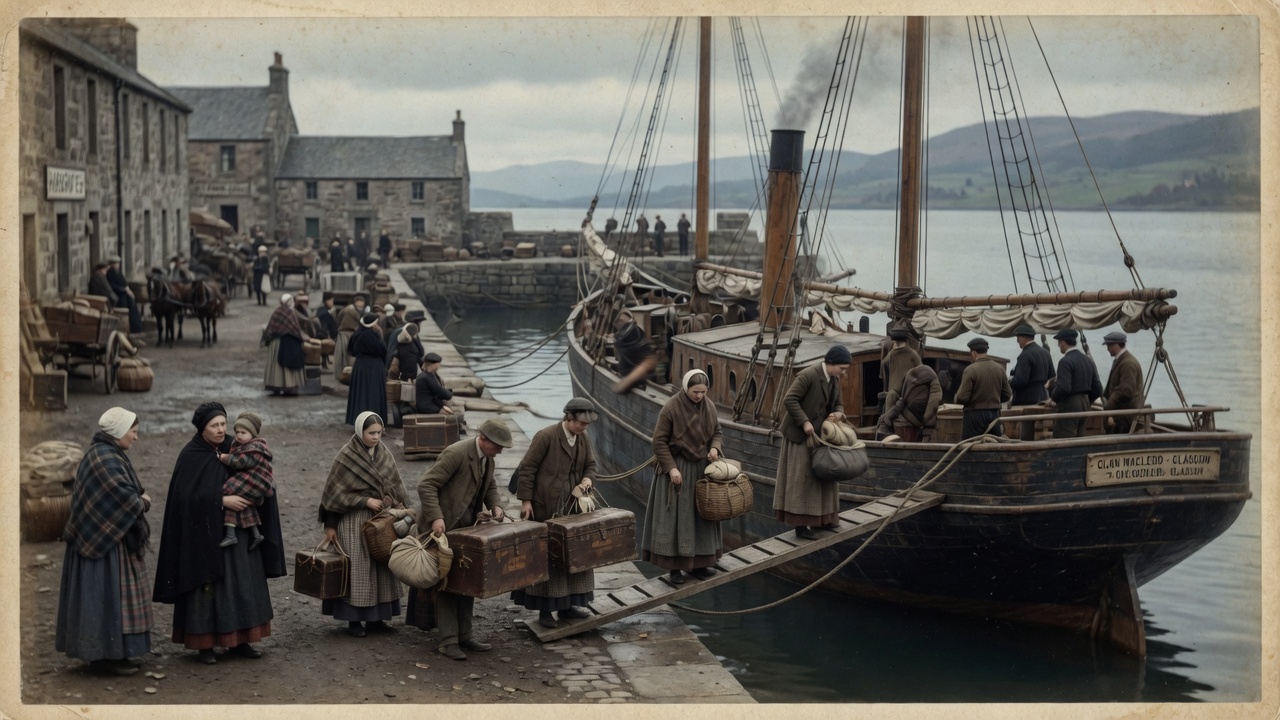
The parish of Lochs takes up the wild, sea-pierced southeastern quarter of Lewis: black peat moor, low rock, and a coast so indented that almost nowhere is more than a mile or two from saltwater. Poor ground and proud people. Learn more about the Isle of Lewis → Donald’s Lewis was overwhelmingly Gaelic-speaking and overwhelmingly Free Presbyterian — a religious culture of extraordinary seriousness, built around the Sabbath and the Gaelic psalm sung in the long, unaccompanied style still called “precenting the line.” To be a McIver of Lochs was to be formed by that faith as much as by that ground, and Donald carried it across the world — which is what makes the marriage he eventually entered so quietly astonishing.
The line can be reached back a little further. A FamilySearch tree confirms Donald’s father as Norman MacIver (c. 1811–1893), and a compiled clan genealogy carries it one more generation, to Neil McIver (c. 1779–c. 1820) and his wife Catherine MacArthur (1775–1862) — names reaching into the eighteenth-century Lewis of the runrig townships, before the Clearances. These earlier generations are tagged inherited, from a secondary compilation not yet checked against Lewis parish registers, but they push the documented horizon back the better part of a century.
Donald was born into the long aftermath of clearance and famine, into a Lewis where the crofts were too small and the future pointed across the Atlantic. He immigrated in 1883. That year matters, because the story here meets two great organised emigration schemes — two emigrant fleets sailing for the same prairie within a year of each other, easy to confuse.
The first was the Cathcart Colony. In 1883 and 1884, Lady Gordon Cathcart — who held vast Hebridean estates including much of South Uist and Benbecula — sponsored the emigration of nearly three hundred Hebridean crofters to southeastern Saskatchewan, settling them in the St. Andrew’s and Benbecula Colonies near Moosomin and Wapella. Each family received a £100 loan against their homestead; they arrived to no houses, lodged in tents, and built their first dwellings of turf and log. In 1888 a church was founded for the Catholic among them, St. Andrew’s parish at Wapella. This is the scheme that fits James Alexander Campbell of South Uist: the right island, the right years, the right destination. It has not yet been nailed to a passenger list, so the story holds it as probable.
The second, the Lothian Colony (1889), brought Lewis crofters to the Stornoway and Kessock hamlets north of Saltcoats — and Donald’s later homestead (NE 36-24-01-W2) sits in that colony’s ground. But Donald arrived six years before it. He was not a Lothian settler; he was a pioneering Lewis emigrant who got there first, and he did not go straight to Saltcoats. He went to the Earlswood/Wapella area, the heart of Cathcart territory, and on 13 February 1888 married Elizabeth Ann “Lizzie” Campbell at Earlswood, Saskatchewan, the same Earlswood where Lizzie’s father, James Alexander Campbell, would be buried in 1920. Donald had settled near the Campbells. Afterward he and Lizzie moved north to the Saltcoats district and took up the homestead quarter the Saskatchewan Archives still carries under his name.
So picture it: within about two years, two fleets of Gaels — Catholics of the southern isles bound for Wapella, Presbyterians of Lewis bound for Saltcoats — crossed the Atlantic, rode the new Canadian Pacific Railway west, and were set down within forty miles of one another on open prairie. They came from islands a hundred miles apart that had, in all the centuries before, almost nothing to do with each other. The land was not the land they had been promised: a short, savage growing season, killing winters, drought, prairie fire, and isolation on a scale no islander had known. The Saltcoats colonies, the records say flatly, had essentially failed by 1900, and the families scattered, many in time to Edmonton. But before they scattered, a McIver met a Campbell. And held.
Interlude — George McIver (1856–1885)The brother the family lost to the Rebellion
1856–1885 · Lewis → Maple Creek, the North-West Rebellion
Donald did not cross the ocean alone, and not every McIver who came west lived to farm it. He had at least two brothers who also made the crossing — Roderick and George — and George’s story is one the wider family has never let go. It was set down in a typed account read aloud on 17 June 1990, when McIver and MacIver descendants gathered to rededicate his grave; it carries the rough edges of family memory rather than the polish of the archive, but its spine sits inside one of the defining episodes of the Canadian West.
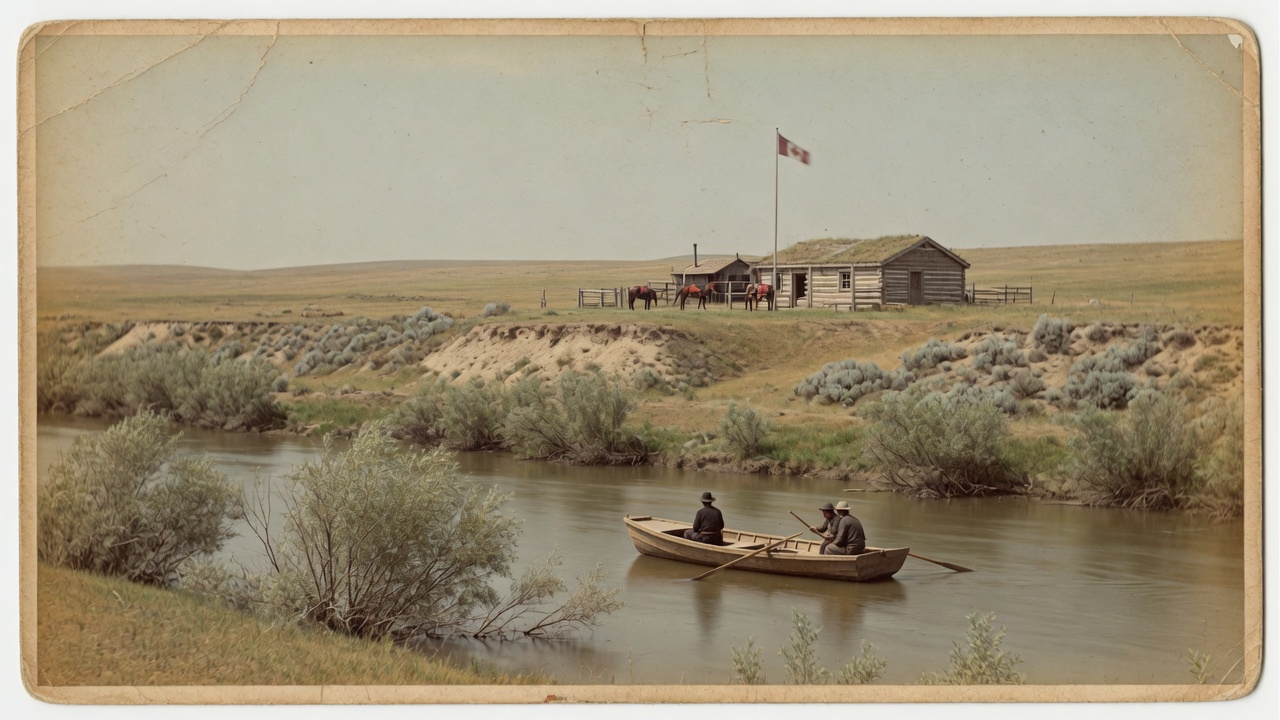
George McIver, born on Lewis around 1856, emigrated young and ranged far — by the family’s account, as far as California. In the spring of 1885 he read that the North-West Rebellion had broken out on the Saskatchewan: Louis Riel and the Métis, with Cree and Assiniboine allies, risen against the Dominion around Batoche and Prince Albert. George had brothers settled in that country and started north to reach them — overland to Fort Calgary, where he built a boat and set out to float down the Bow and the South Saskatchewan. On 23 July 1885, having pulled ashore to cook a meal, he was fired upon from the riverbank, shoved his boat back into the current, and escaped downstream, bleeding badly. He was carried to the North-West Mounted Police post at Maple Creek, where he died of the wound on 29 July 1885, by the family’s account the first person buried in the Maple Creek cemetery. Learn more about the North-West Rebellion →
There is a final, aching turn: for more than a century his grave bore the wrong name, “William McIvor”, and the family lost the place where he lay. Only in 1989 did they find him again; a new cross was cut with his right name, and the next summer the family rededicated it, closing with a Latin vow: Nunquam obliviscar — I shall never forget.
Two honest cautions belong with this. It is family memory committed to paper in 1990, not a contemporary record; the fine details — above all the identity of whoever fired on him — are exactly what a century of retelling hardens, and the 1990 text names a Cree chief in a way no contemporary source confirms, so that particular is best left unrepeated. And the account places Donald and Roderick “near Prince Albert” that year, whereas Donald’s documented homestead lies far to the southeast near Saltcoats; so either Donald was first in the Prince Albert country, or the telling simply blurred the map. The shape, though, is not in doubt: the McIver brothers came out of Lewis into a raw and dangerous country, and one of them did not survive his first Canadian summer, killed in the violent making of the very province his nieces and nephews would help to settle. George left no children.
Chapter ThreeDonald and Lizzie (married 1888) — the improbable marriage
m. 13 Feb 1888 · Earlswood, Saskatchewan · twelve children
On 13 February 1888, at Earlswood, Saskatchewan, Donald George McIver of Lewis married Elizabeth Ann “Lizzie” Campbell of South Uist. Set down in a line, it can pass for an ordinary frontier wedding. It was not.
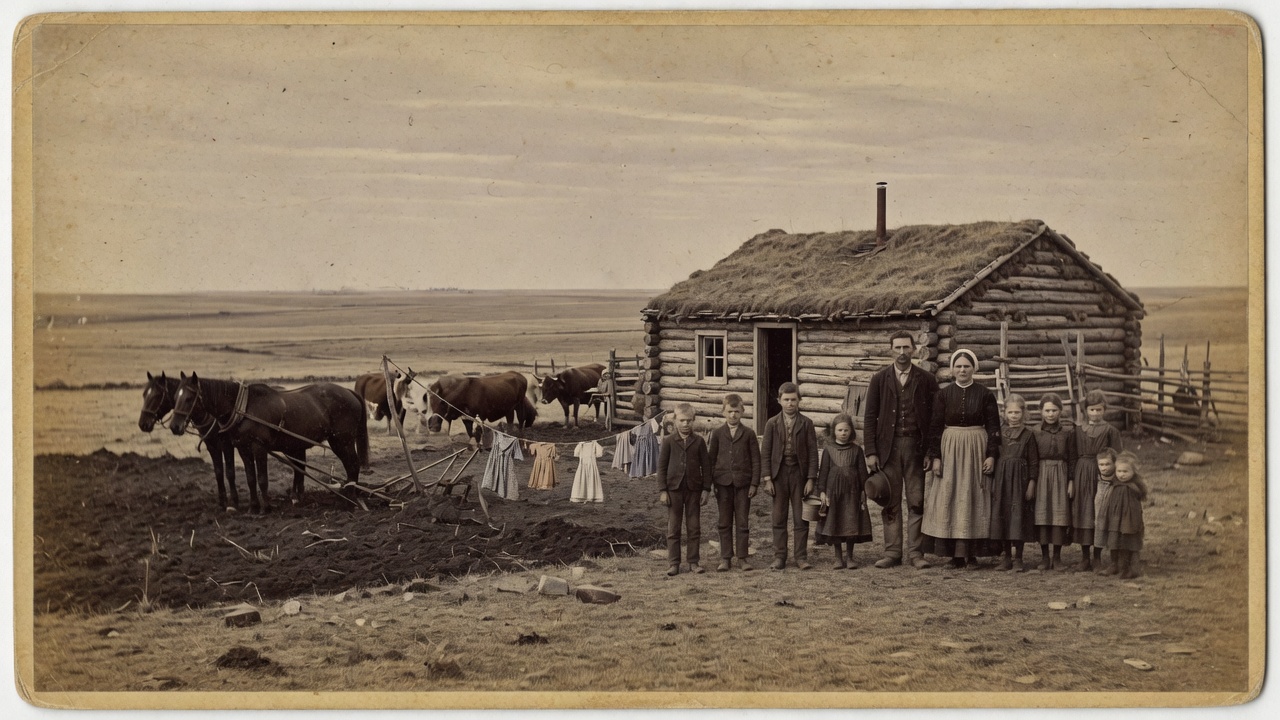
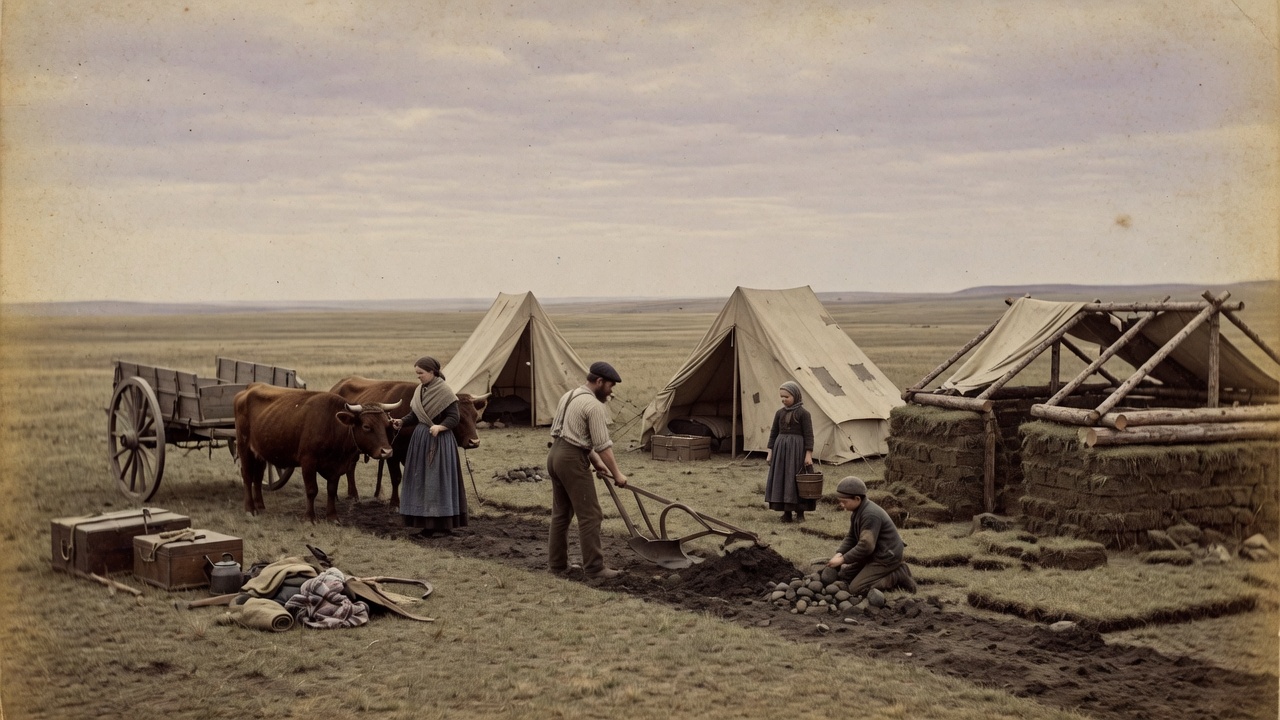
Donald was Free Presbyterian, of Lewis, a rigorously Protestant culture. Lizzie was, by the island geography, Roman Catholic of South Uist — one of the last redoubts of the old faith. Whether the wall was truly there to cross, we cannot be certain: the framing is an inference from island geography, not a fact the records establish (see the Notes). What is certain is that the line they began was Protestant within a generation. But in the islands these two communities lived in settled mutual incomprehension, separated by a confessional boundary that structured everything: who you married, which church bell ordered your week, how you were buried. A Lewis Presbyterian and a Uist Catholic marrying in the old country would have been close to unthinkable — a scandal in two parishes at once.
And on the prairie, they crossed it. The honest truth is that the mechanics are unresolved: which congregation hosted it, whether a minister or a priest pronounced the words, whose church the children were christened in. We can write the crossing; we cannot yet write the ceremony, and we will not invent one. What we can say is what the crossing meant: eight thousand kilometres from home, with the old parish structures left behind, two people from across the deepest line their society knew decided it mattered less than the marriage. Either way, their union is a small early foreshadowing of the largest theme in this whole family — the way that, marriage by marriage, faith after faith and people after people would fold together until, lifetimes later, they all ran in the veins of the same three children.
They raised an enormous family — twelve children the records name, very likely more the records have lost — and the bare roll is itself a portrait of frontier life in all its fertility and grief:
- Norman George McIver, born 24 November 1889 — of whom much more in the next chapter; his is the name carved on a war memorial in France.
- John Duncan McIver, born 7 October 1890 — and dead on 7 February 1891, four months old. An infant lost to a prairie winter.
- James Roderick McIver, born 29 April 1893 — the direct ancestor: the grandmother’s father (Chapter Five). He married Mary Ann Birse and died in Edmonton in 1973.
- Catherine McIver (later Morphy), born 29 July 1895; she lived to 1988 and died back in Saltcoats — the only child buried near where she was born.
- Duncan McLeod McIver, born 20 May 1897; died 1958, Edmonton.
- Henrietta Margaret McIver, born 24 August 1899; died 1972, New Westminster, BC.
- John Alexander McIver, born 28 May 1902 at Saltcoats; died 1970, Edmonton.
- William Donald McIver (“McIvor” in his record), born 4 June 1904; died 1981, Edmonton.
- Neil Malcolm McIver, born 23 September 1906; died 1975, New Westminster.
- Walter Gordon McIver, born 27 December 1908; died 1975, Edmonton.
- Elizabeth Ann McIver, born 9 March 1912 — a daughter of Donald and Lizzie, not to be confused with her niece, the grandmother Elizabeth Annie (born 1919).
- Christina Agnes McIver, born 12 December 1915; she travelled furthest of all, dying in 1976 in Boone, Indiana.
Read that list slowly and you can see the whole shape of the family’s century in it. An infant lost in the hardest pioneer years; a son killed in the Great War; and then a long roll of children who survived, grew up, and — one after another, as the colony failed and the prairie emptied — left: to Edmonton, again and again, and to British Columbia, and one all the way to the American Midwest. The McIvers came to Saskatchewan to put down roots, and the soil would not let them. So they did what their parents had done in the Hebrides: they crossed once more, and went looking for a place that would hold them.
Donald himself died in Edmonton on 27 November 1932 — having lived to see his colony fail, his family scatter west, and one of his sons buried overseas. Lizzie outlived him by a dozen years, dying in Edmonton on 24 March 1944, in the middle of another world war. The man from Lochs and the woman from South Uist, who had crossed a confessional wall to marry on the open prairie, lie at the end in the same Alberta city — their long, improbable union outlasting the colony that brought them together and the islands that drove them out.
The oldest islanders never left that ground at all. Lizzie’s parents finished their long lives where the crossing had set them down. James Alexander Campbell, the old Catholic of South Uist, lived out his years in the Wapella district and died there on 31 March 1920, aged eighty-seven — born the year before the Empire abolished slavery, dead two years after the Armistice of the war that had taken his grandson Norman. He is buried at Earlswood Cemetery among a cluster of Campbell graves — James himself, his sons Neil Alexander and Duncan — and Catherine Cameron, the family record holds, also died in the Wapella country, though which Earlswood stone is hers is a question the Notes take up honestly. They ended their crossing in soil no factor could clear them from, because at last it was theirs.
Chapter FourNorman George McIver (1889–1917) — the one the family gave to the war
1889–1917 · Saltcoats → Villers Station, France
Every family that lived through 1914 to 1918 was asked, one way or another, to pay. Most lines in this larger family sent sons toward that war and — by luck, distance, or age — got them back. One line did not. The McIvers of Saltcoats paid the full price, and the record of it is not a family story softened by retelling but a hard fact set in stone and bronze, verified by the war-graves authorities of two countries.
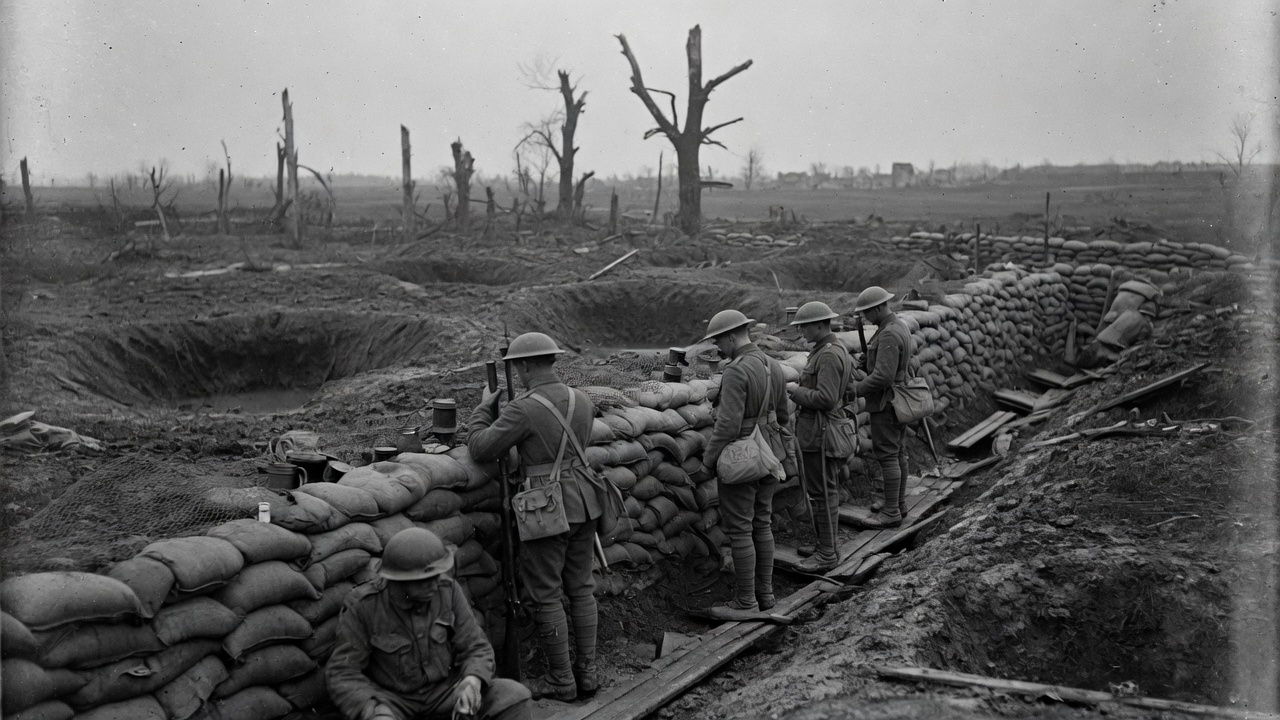
Norman George McIver was the eldest son of Donald and Lizzie, born 24 November 1889 in the early colony years. He grew up on the Saltcoats prairie, one of that crowd of brothers and sisters, in the Gaelic-inflected, hard-working household his parents had built between Lewis and South Uist. And when the war came, he went.
He enlisted in the Canadian Expeditionary Force — attesting on 9 February 1916 at Yorkton, Saskatchewan — service number 887432, and was posted to the 46th Battalion (Saskatchewan Regiment), a unit that would earn, in the grinding attrition of the Western Front, the grim nickname “the Suicide Battalion.” Private Norman George McIver, a prairie boy of an island family, went to France to fight in the worst war the world had yet seen. He was killed on 3 June 1917; the war-graves record gives his age as twenty-six.
That date places his death in the bloody aftermath of the Battle of Vimy Ridge, the great Canadian assault of April 1917 in which all four divisions of the Canadian Corps fought together for the first time. The fighting did not stop when the ridge was taken; through May and into June the Canadians held and pushed forward against ferocious German shellfire, and it was in that grinding, “ordinary” trench warfare — the daily slaughter the famous battles were embedded in — that Norman George died.
He is buried at Villers Station Cemetery near Villers-au-Bois, northwest of Arras — in France, not the “Vimy Ridge, Belgium” of the old tree; the Notes carry the correction. His grave reference is VIII. C. 12. The Commonwealth War Graves Commission and the Canadian Virtual War Memorial both hold his record, and both set beside his name his parents’: son of Donald and Elizabeth Campbell McIver, of Saltcoats, Saskatchewan.
That parental line is its own small miracle of the record. It means that in the permanent memory of the nation he died for, the names of the man from Lewis and the woman from South Uist stand together — husband and wife, Presbyterian and Catholic, their improbable prairie marriage attested forever by the war that took their son. It is the single most solidly documented fact in this entire family story, and a heartbreaking one: the firmest stone the family stands on is a grave in France.
A boy whose grandparents had been cleared off Hebridean crofts by sheep and famine; whose parents had crossed an ocean and a confessional wall to break new ground on the Saskatchewan plain; who was born under a prairie sky into a colony already failing — that boy lies now in a war cemetery in northern France, under one of the rows of identical white stones that mark where a generation of the world’s young men was spent. He has no descendants. He is a great-great-great-granduncle to the children this story is for. But he is the family’s witness — the proof that this line did not merely survive history but was wounded by it. Patience, Daniel, and Faith should know his name: Norman George McIver. Three June, 1917. Villers Station. Grave VIII. C. 12.
Chapter FiveJames Roderick McIver and Mary Ann Birse — the chair that was empty, and is now filled
1893–2002 · James Roderick McIver & Mary Ann Birse
Now we come to the generation through which everything passes — and to a satisfying turn in the making of this story: a chair that sat empty through its first telling, and has since been filled.
When this story was first written, the record went quiet exactly here. The family tree said Thomas’s grandmother, Elizabeth Annie McIver, was the daughter of John Alexander McIver and an unnamed wife — and that wife, the direct great-grandmother of the line, had no name anywhere in the record. There was an empty chair at the table of this generation, a blank where a whole person belonged. This story refused to fill it with a guess; it left the chair empty, pointed to where she should be, and promised to keep looking.
Then the looking paid off — through a set of family records held by Thomas’s uncle David Docherty: the McIver family bible, and a painstaking genealogy compiled by the wider McIver clan. Together they filled the chair, and revealed that it had been set in the wrong place all along. For the tree had the wrong father. Elizabeth Annie was not the daughter of John Alexander McIver. She was the daughter of his older brother, James Roderick McIver — and the arithmetic alone should have warned us. John Alexander, born in 1902, would have been just seventeen when Elizabeth Annie was born in 1919; James Roderick, born at Saltcoats on 29 April 1893, was twenty-six, exactly the age to be a father. The two were brothers, both sons of Donald and Lizzie, and somewhere in the long assembling of the tree one had been quietly written in for the other.
And the woman in the chair — the great-grandmother — was Mary Ann Birse. She had been in the family’s records the whole time, mislabelled merely an “aunt” when she was in truth the direct great-grandmother. She was born at Saltcoats on 12 August 1900, married James Roderick on 15 August 1917 (the entry sits in the McIver bible’s own marriage register), and outlived very nearly everyone else in this story: she died in Edmonton on 28 October 2002, at the age of one hundred and two. A woman born into the failing Hebridean colony on the Saskatchewan prairie, in the reign of Queen Victoria, lived to see the twenty-first century; at her funeral, her grandson David Docherty was a pallbearer.
James Roderick and Mary made the family’s second great crossing — the drift from the failing colony land to Edmonton. Their eldest, Jonathan Roderick McIver, was born in 1918 and died the same year, an infant lost. Then came Elizabeth Anne, the grandmother, in 1919. Then Eleanor Mary Jane in 1921, who married into the Golden family and became, across her own long life, the keeper of the family’s dates and stories: it was “Aunty Eleanor” whose careful lists, decades later, supply so much of what this very story is built on. The woman in the once-empty chair raised the family’s own historian.
John Alexander McIver — the brother the tree mistook for the father — keeps his honest place in the record, just not this one. He was born at Saltcoats on 28 May 1902 (registration #1831 names his parents as Donald G. McIver and Lizzie Campbell, a third independent attestation of the prairie marriage); he married Mary “Donna” Coleman in Edmonton in 1944 and died there on 30 December 1970. He was a great-grand-uncle of the line, not its great-grandfather.
One gold-standard confirmation remains available — Elizabeth Annie’s own 1919 Saskatchewan birth registration, which names James Roderick and Mary outright, and which is now past its hundred-year seal. But the chair is no longer empty. It holds a woman named Mary Ann Birse, who lived a hundred and two years, and beside her James Roderick McIver, her husband and the grandmother’s father. Buanseasmhachd cuts both ways: it is what kept the chair honestly empty until the truth could come and fill it.
Chapter SixElizabeth Annie McIver (1919–1988) — the grandmother who carried the islands into the family
1919–1988 · Saltcoats → Alberta · the islands come ashore
Elizabeth Annie McIver — the daughter of James Roderick McIver and Mary Ann Birse — was born at Saltcoats, Saskatchewan, on 20 March 1919, in the first spring after the Great War, two years after her uncle Norman George had been buried in France. She was baptized that spring, on 27 April 1919, at Perley, Saskatchewan, by the Rev. C. Murdoch, and the small detail does quiet work, for a Presbyterian baptism places this McIver–Campbell family, only a generation on from the islands, firmly inside the Protestant church (see the Notes on the religion question). She was the last of this family to be born on the Saskatchewan prairie the islanders had broken; in her, the long Hebridean stream finally turns toward Alberta for good.
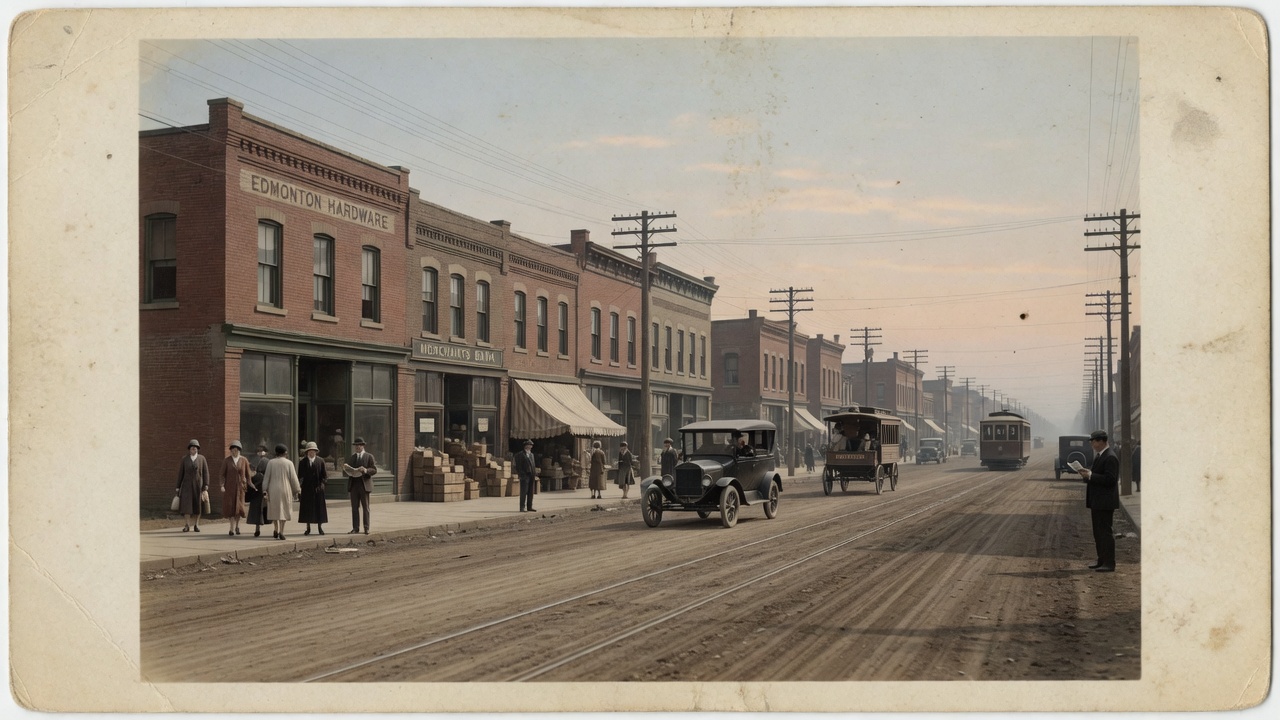
For she, too, made the family’s characteristic crossing — not over an ocean this time, but over the distance of a young country, from the failing colony land into the same Edmonton that had drawn so many of her aunts and uncles. And it was in central Alberta that the Hebridean line met the Irish one, when Elizabeth Annie McIver married Thomas Richard Docherty — the wedding held at the Docherty home at Alix on 15 August 1941. Thomas Richard was born in 1914 at Alix, the son of a line that ran back through the coal-and-iron towns of industrial Scotland to a Protestant-Irish emigration out of Donegal (that line’s story tells itself elsewhere). When they married, two of the great migrant streams of the British Isles ran together: the cleared Gaels of the Hebrides and the Ulster-Irish out of Donegal, both driven from their homelands by the same long century of landlordism and hardship, both fetching up at last in Alberta.
Elizabeth Annie lived a long Alberta life and died in Edmonton on 28 April 1988, in the same city where her father, her grandfather Donald, and her grandmother Lizzie had all died before her, the city that had become the McIvers’ true terminus after the islands and the prairie. She is the maternal grandmother of Thomas Cheesman: close enough to living memory that the family remembers her as a grandmother, not as an entry in a record. Through her, every stream in this story — Lewis and South Uist and Moray, McIver and Campbell and Cameron, the Gaelic psalm and the machair and the moor — flowed down into her daughter, and from her daughter into Thomas.
Her daughter, Thomas’s mother, is Elizabeth Maryanne, born in 1959. With her the story crosses out of history and into living family, and so, in keeping with this family’s care for the privacy of the people still alive in it, the narrative does not linger over her or the children’s other living relations. It is enough to say that Elizabeth Maryanne carried the whole Hebridean inheritance — her own mother’s islands, her own father’s Ireland — forward one more generation, to a son born in Calgary. And there the Hebridean stream meets the rest of the rivers.
The Living LineWhere the Hebridean rivers join the others
Grande Prairie · where the Hebridean rivers join the others
History always flows to the present, and for the Hebridean stream that began on three islands and a glen before any of these dates were written down, that present is now.
The McIver descent
- Born c. 1779 and 1775 — names reaching into the eighteenth-century Lewis of the runrig townships, before the Clearances
- From a compiled clan genealogy not yet checked against the Lewis registers — held inherited, the deepest reach of the line
- Norman (c. 1811–1893) is Donald’s father per FamilySearch — held probable pending the parish registers
- Henrietta’s given name drifts across the family GEDCOMs — Henrietta, Effie, Helen — a MacAulay of Lewis
- Their son George was shot from a riverbank in the 1885 Rebellion summer and died at Maple Creek — for a century his grave read “William McIvor”
- James, born South Uist 1 November 1832 — a Gaelic-speaking Catholic crofter under Gordon of Cluny’s clearances
- Catherine, of Urquhart in Moray by the Spey-mouth, c. 1844 — held probable: her baptism has not yet been pulled
- Crossed past fifty, fitting the Cathcart Colony of 1883–84 to Wapella — probable, not yet nailed to a passenger list
- James died 31 March 1920, aged eighty-seven, buried at Earlswood among a cluster of Campbell graves
- Donald of Lochs, Lewis, crossed in 1883 — six years ahead of the Lothian Colony, a pioneering Lewis emigrant
- Married Lizzie of South Uist at Earlswood, 13 February 1888 — by the island geography, a marriage across the deepest confessional line the Hebrides knew
- Twelve children the records name; the Saltcoats colony had essentially failed by 1900, and the family drifted to Edmonton
- Their eldest, Norman George, fell near Vimy on 3 June 1917 — 46th Battalion CEF, Villers Station Cemetery; his war record names both parents
- Donald died in Edmonton 27 November 1932 (the family bible’s date); Lizzie followed in 1944
- Born Saltcoats 29 April 1893 — SK registration #979 names Donald and Lizzie outright
- Mary Ann Birse filled the record’s empty chair — mislabelled an “aunt” for decades, proven the great-grandmother by SK reg #3985
- Married 15 August 1917 — the entry sits in the McIver bible’s own marriage register
- Their firstborn, Jonathan Roderick, was lost in infancy, 1918; their youngest, Eleanor, became the family’s own historian
- Mary lived to one hundred and two — born under Victoria in 1900, died Edmonton, 28 October 2002
- Born Saltcoats 20 March 1919, baptized Presbyterian at Perley that spring — the last of the family born on the colony prairie
- Married Thomas Richard Docherty at the Docherty home at Alix, 15 August 1941 — the Hebridean and Irish streams run together
- Died in Edmonton, 28 April 1988 — close enough to living memory to be a real grandmother, remembered
- The whole Hebridean inheritance — Lewis, South Uist, and Moray — passed through her to a son born in Calgary
- Daughter of the Alix household where the McIver and Docherty lines married — her own telling lives in the Docherty story
- Married 2 July 2016 in Calgary
- The parents of Patience, Daniel, and Faith
- Born 2013, 2015, and 2017, all in Grande Prairie
- Heirs of all eight family lines — the confluence this whole site is built around
The current runs down through the grandmother, Elizabeth Annie McIver, into her daughter Elizabeth Maryanne, and from her into Thomas Cheesman, born in Calgary on the fourth of November, 1980. Thomas carries the islands in his blood: Lewis and South Uist and Moray, the McIver and the Campbell and the Cameron, the Free Presbyterian moor and the Catholic machair, the marriage that crossed the confessional wall on the open prairie. He also carries, through his mother, the Docherty line — the famine-Irish current out of Donegal and industrial Lanarkshire that ran together with the McIver line when Elizabeth Annie married Thomas Richard Docherty. And through his father, Martin Gerard Lakeman, born in Calgary in 1957, he carries the Lakeman line — three centuries of Dutch polder and the Indies and a long sea-going history of its own. The name he himself bears and passes on, Cheesman, is a chosen channel rather than a blood one: the surname of his step-father’s family, taken not by descent but by belonging.
Thomas and Melanie Haiste — born in Grande Prairie in 1983, herself the meeting-place of the Haiste line out of Yorkshire and Saskatchewan and the Rycroft and Steinke lines out of Leeds and Hawai’i and the Peace Country — married in Calgary on the second of July, 2016. They are the parents of three children, raised in Grande Prairie:
- Patience, born 24 September 2013;
- Daniel, born 30 June 2015;
- Faith, born 30 March 2017.
The McIvers and the Campbells and the Camerons spent their buanseasmhachd in full. They were cleared off three homelands and they held. They crossed the water — a’ dol thar a’ chuain, the hardest journey of all — and they held. They lost a son to a war, a colony to the climate, and the name of a great-grandmother to the silence of the record, and still something came through. Patience, Daniel, and Faith inherit it together. They are the far shore. They are what buanseasmhachd was for.
Lineage at a glance
| Generation | Name | Born | Died | Place of life | Confidence |
|---|---|---|---|---|---|
| 1 | Neil McIver & Catherine MacArthur | c. 1779 / 1775 | c. 1820 / 1862 | Isle of Lewis (Lochs) | Inherited — secondary family compilation only |
| 2 | Norman MacIver & Henrietta / Effie / Helen (MacAulay) MacIver | c. 1811 / — | 1893 / 1897? | Isle of Lewis (Lochs) | Probable — Norman as Donald’s father per FamilySearch; MacAulay a Lewis surname |
| 2 | James Alexander Campbell | 1 Nov 1832 | 31 Mar 1920 | South Uist → Wapella / Earlswood, SK (bur. Earlswood) | Probable (origin) / Verified (Earlswood burial cluster) |
| 2 | Catherine (Cameron) Campbell (wife) | c. 1844 | Wapella district, SK (date unresolved) | Urquhart, Moray (Spey Bay, OPR #144) → SK | Probable — tree assertion; baptism not yet pulled |
| 3 | Donald George McIver | 1850 | 1932 (27 Nov per family bible / 27 Dec per FamilySearch) | Lochs, Lewis → Earlswood / Saltcoats, SK → Edmonton | Verified — SK regs; CVWM; m. Earlswood 13 Feb 1888; immigrated 1883 |
| 3 | Elizabeth “Lizzie” (Campbell) McIver (wife) | c. 1860 | 24 Mar 1944 | South Uist → Saltcoats, SK → Edmonton | Probable (origin) / Verified (named mother on SK reg #979 & CVWM) |
| 4 | Norman George McIver (collateral — killed in action) | 24 Nov 1889 (bible; attestation/CWGC 1890) | 3 Jun 1917 | Saltcoats, SK → France (Villers Station, gr. VIII. C. 12) | Verified — CWGC / CVWM #59994, service #887432 |
| 4 | James Roderick McIver (great-grandfather) | 29 Apr 1893 | 1973 | Saltcoats, SK → Edmonton | Verified — SK birth reg #979: father Donald G. McIver, mother Lizzie Campbell |
| 4 | Mary Ann (Birse) McIver (great-grandmother) | 12 Aug 1900 | 28 Oct 2002 (age 102) | Saltcoats, SK → Edmonton | Verified — named mother on SK reg #3985; compiled genealogy had “Mary Rodgers” — primary record corrects to Birse |
| 4 | John Alexander McIver (collateral — long mistaken for the great-grandfather) | 28 May 1902 | 30 Dec 1970 | Saltcoats, SK → Edmonton | Verified — birth reg #1831; not the direct ancestor |
| 5 | Elizabeth Annie (McIver) Docherty (grandmother) | 20 Mar 1919 | 28 Apr 1988 | Saltcoats, SK → Alberta → Edmonton | Verified — SK birth reg #3985 (father James R. McIver, mother Mary Ann Birse); funeral card Eastminster Presbyterian 1988 |
| 5 | Thomas Richard Docherty (grandfather; m. Elizabeth Annie) | 16 Jan 1914 | 20 Mar 1977 | Alix, Alberta | Verified / Living memory |
| 6 | Elizabeth Maryanne (Docherty) Cheesman (Thomas’s mother) | 1959 | — | Alberta | Living memory |
| 7 | Thomas Cheesman | 4 Nov 1980 | — | Calgary, Alberta | Living memory — carries McIver / Campbell / Cameron (+ Docherty) via his mother; surname Cheesman chosen, from step-father Brian Cheesman |
| 8 | Patience | — | — | Grande Prairie, Alberta | Living memory |
| 8 | Daniel | — | — | Grande Prairie, Alberta | Living memory |
| 8 | Faith | — | — | Grande Prairie, Alberta | Living memory |
Confidence tiers: Verified — anchored to at least one primary register or government record (parish register, civil registration, census, CWGC, homestead file). Probable — rests on indexed family-tree compilations consistent across sources but lacking direct primary-register confirmation. Inherited — rests on the family genealogy without independent primary verification. Living memory — recent enough to be remembered directly by family.
Side-branches named in the records but off the direct line: Donald’s brothers George McIver (1856–1885), killed in the North-West Rebellion and the first burial at Maple Creek (see the Interlude), and Roderick Angus McIver; the eleven brothers and sisters of James Roderick named in Chapter Three; the Campbell sons Neil Alexander and Duncan of the Earlswood cluster; and Kenneth McIver (1836–1933) of Saltcoats, whose exact link to Donald is still unresolved.
Notes on the records
This branch of the family is, unusually, well supported by primary records — far better than the paternal Docherty line, which rests largely on tree-assertions about pre-Famine Ireland. The McIver/Campbell/Cameron stream can be written with real confidence, precisely because its strongest facts come not from family lore but from government registers, census enumerations, cemetery transcriptions, and war-graves records. But confidence is not completeness, and several threads are tagged honestly here so no reader mistakes a plausible inference for a proven fact.
The McIver family bible — a key primary source. A set of photographs of the McIver family bible and related papers, held by Thomas’s uncle David Docherty, materially strengthens the record. The bible’s handwritten births, marriages, and deaths registers — contemporaneous family entries — confirm the sibling list of Donald and Lizzie’s children and several dates the story had taken from the tree, and settle one tree-builder error for good: the Elizabeth Ann born 9 March 1912 is recorded plainly as a daughter of Donald and Lizzie — a sibling, not (as the old data had wrongly slotted her) the grandmother or John Alexander’s wife. The deaths register gives Donald’s death as 27 November 1932, a month earlier than the compiled tree’s December date; the register, written nearer the event, is the better authority. Two funeral cards in the same collection — Elizabeth Annie’s (1988, Eastminster Presbyterian) and Mary Ann McIver’s (2002, Mill Woods Presbyterian) — anchor the family’s Protestant church life. And, most consequentially, the compiled McIver genealogy in the same collection cracked the missing-great-grandmother puzzle: it shows Elizabeth Annie as the daughter of James Roderick McIver and Mary Ann Birse, not John Alexander.
1. The verified bedrock.
- Norman George McIver’s war death. Service #887432, Private, 46th Battalion CEF, killed 3 June 1917, buried Villers Station Cemetery, France, grave VIII.C.12 — held by both the Commonwealth War Graves Commission and the Canadian Virtual War Memorial (entry 59994). His CEF personnel file (LAC Item ID 164000) gives birth 24 Nov 1890 and enlistment 9 Feb 1916 at Yorkton; the CVWM independently names his parents as Donald and Elizabeth Campbell McIver of Saltcoats — a priceless second attestation of the marriage, independent of the family tree. (On the birth year: the bible’s 24 Nov 1889 is preferred here, since brother John Duncan’s October 1890 birth rules out a late-1890 Norman; the attestation’s “1890” is the kind of slip common on enlistment papers.)
- John Alexander McIver’s birth. SK birth registration #1831, born 28 May 1902 at Saltcoats, mother Lizzie Campbell, father Donald G McIver — a third independent confirmation of the parents’ union.
- Donald’s Saltcoats homestead, catalogued in the Saskatchewan Archives pre-1930 homestead records as NE 36-24-01-W2 (ref. S 42.687816, confirmed against the live PAS catalogue), with a second file at W 6-13-01-W2 (S 42.462861). Both are order-only; the homestead file would give Donald’s island of origin and arrival year.
2. Corrections carried into the narrative.
- Norman George died in FRANCE, not “Vimy Ridge, Belgium.” Vimy is in France; his burial is at Villers Station Cemetery, ~11 km NW of Arras.
- John Alexander McIver died 30 December 1970 in EDMONTON, not November 1940 in Saltcoats. The “1940 Saltcoats” entry is a misreading of a Saltcoats stone for a different, younger John McIver.
- The Campbell cluster is buried at EARLSWOOD Cemetery, RM Martin No. 122 — not at Kelso / RM Walpole as the tree had it.
- The Lothian Colony near Saltcoats is dated 1889; Donald immigrated in 1883 and so predated it — an early independent Lewis emigrant, not a Lothian settler. (An earlier draft mis-dated the colony to “1884–85.”)
- The great-grandmother’s maiden name is BIRSE, not “Rodgers.” Aunty Eleanor’s data sheets called her “Mary Rodgers”; the primary SK birth registration (#3985, naming Elizabeth Annie’s mother) settles it as Mary Ann Birse.
3. The settlement schemes — held as probable. The two emigrant fleets are documented facts; the family’s placement in them is a strong but unproven inference. The Campbells of South Uist fit the Cathcart Colony (1883–84) to Wapella/Moosomin on island, years, and destination; a local history (J. N. MacKinnon, A Short History of the Pioneer Scotch Settlers of St Andrew’s, 1922) and aggregated trees point to a Campbell arrival at Quebec in May 1884 with Cathcart’s second contingent — a promising lead, not yet nailed to a manifest. The McIvers of Lewis settled in the Saltcoats district later organised around the Lothian Colony (1889), but Donald arrived in 1883, ahead of it.
4. The marriage, and the religion question. That Donald of Lewis married Lizzie Campbell of South Uist is attested three times over — the CVWM parental line on Norman George’s war record, John Alexander’s birth registration, and the consistent family record. What is not attested is the couple’s religions: the “Free Presbyterian × Roman Catholic” framing is an inference from island geography (Lewis Protestant, South Uist Catholic), not a fact those records establish. And the family’s later record cuts against the dramatic version — the children and grandchildren were Protestant (Elizabeth Annie’s 1988 funeral at Eastminster Presbyterian; Mary Ann’s 2002 at Mill Woods Presbyterian; the extended family’s weddings ran Presbyterian, Baptist, Anglican, Lutheran, United — never Catholic). So either Lizzie came from South Uist’s Protestant minority, or (if Catholic-born) the family assimilated wholly to Presbyterianism in Canada. The cross-confessional marriage remains possible, even likely on the geography — but it is a hypothesis, not documented drama.
5. Catherine Cameron — the probable great-great-great-grandmother. Her birth (~1844), her Moray origin (Urquhart / Spey Bay, OPR parish #144), and her marriage to James Alexander Campbell all come from the family tree and are consistent with the records but not yet retrieved from a primary source. Her baptism, if the date is right, should lie in OPR #144. There is also an unresolved death question: a “Kate Campbell, wife of James,” died 24 August 1890 aged 43 and is buried at Earlswood — she may be Catherine (with the birth-year off by a few years) or an earlier wife. A newer wrinkle sharpens it: an 1866 marriage date for James and Catherine has surfaced in aggregated trees, which would post-date Lizzie’s c. 1860 birth — raising the possibility that Lizzie was the daughter of an earlier wife of James, or that one of the dates is simply wrong. The 1866 marriage record and Lizzie’s own baptism would resolve it.
6. The great-grandmother — FOUND, confirmed by primary record. This was, in the first draft, the single largest gap. A MyHeritage search of the Saskatchewan Births 1832–1921 collection (30 May 2026) returned SK birth reg #3985 (Elizabeth Annie McIver, b. 20 March 1919 — father James R. McIver, mother Mary Ann Birse) and SK birth reg #979 (James Rodrick McIver, b. 29 April 1893 — father Donald G. McIver, mother Lizzie Campbell). Both parentage rows are now Verified, and the wrong-father and “Mary Rodgers” errors are corrected.
7. Donald George McIver — origin and parents. A FamilySearch Family Tree record (retrieved 30 May 2026) gives birth 1850, Lochs (corrected from the compiled tree’s ~1856); residence 1881 at Carloway; immigration 1883; marriage 13 February 1888, Earlswood; parents Norman MacIver + Henrietta / Effie / Helen MacIver (born MacAulay) — family GEDCOMs vary her given name and one records her death in 1897; and siblings including Roderick Angus McIver and George McIver (the 1885 Rebellion casualty). This is a compiled tree, treated as Probable for birth year, parents, and immigration year pending the PAS homestead file or ScotlandsPeople records — but its detail is consistent with every primary record we hold. (The 1891 Scotland Census Donald McIver of Barvas/Arnol is a different man; ours had been in Canada since 1883.)
8. What the next research should do. In rough order of value: order the PAS homestead file for NE 36-24-01-W2 (S 42.687816) to confirm Donald’s island of origin and arrival; retrieve ScotlandsPeople for Catherine Cameron’s ~1844 baptism (OPR #144), the 1866 Campbell–Cameron marriage, Lizzie’s birth, and the deep Lewis (Lochs / Free Church) McIver generations; obtain the full Earlswood Cemetery transcription to resolve the “Kate Campbell 1890” identity; and pull Mary Ann Birse’s own 1900 birth registration and parents.
This is a living document. As the records give up more of what they hold — and on this branch, unusually, they still have a great deal to give — it will be revised. The aim is not a finished monument but a faithful one: confident where the evidence is strong, honest where it is thin, and never willing to invent a parent, a parish, or a date to make a sentence read more smoothly than the truth allows.
Last updated
Download this story as a keepsake PDF
Next line → The Lakemans — family line 04 of 08