
Discretionary income is healthy!
Discretionary income is the income left over after paying for the basic cost of living. Discretionary income in Canada refers to the amount of money an individual or household has available after paying for all necessary or essential expenses. My basic living cost is likely different than someone in Vancouver or Whitehorse but the idea stands that a every person needs a basic minimum of funds to live depending on where they live. Discretionary income is the income you can chose to spend instead have to spend where you need to live. It stands to reason that the poorer we are the less income we have to cover basics. We have broken, abrasive systems and programs, and a general lack of cohesion. It’s a patch up of volunteers, non profits, provincial, municipal, and federal funding. There is no unified Program or entity that ensures the homeless are taken care of and the low income earners have opportunity to advance careers and skills if they like. Being Disabled myself, it would be a huge benefit to have help going back to school on line and finding ways to afford childcare or help to do it.

Discretionary income is like a nice warm bowl of soup. It tastes delicious, smells great, feels awesome, and looks like a piece of art. These feelings are what make us healthier and happier. Unfortunately a lack of discretionary income often means cheap and over processed food that lack proper nutrition and sustenance.
The Importance of Discretionary Income for People -Not just people with disabilities
- Enhanced Quality of Life: Discretionary income allows individuals to afford not just the necessities but also items and services that improve their quality of life. This might include adaptive technologies, hobbies, or social activities, which are essential for mental health and social inclusion. From X posts to Meta, to the Mainstream media, we see sentiments expressing frustration over the high cost of living adjustments not keeping pace with actual needs, highlighting the continuous struggle for basic comfort and social engagement.
- Economic Flexibility: For many on public support, every dollar is accounted for, often leaving no room for unexpected expenses or personal treats. Discretionary income provides a buffer, reducing stress related to financial unpredictability. This flexibility can lead to better health outcomes and less reliance on emergency services, indirectly benefiting society by reducing healthcare costs and continuous pressure on food banks and municipal supports geared to the lowest income earners and homeless.
- Encouraging Employment: The fear of losing benefits due to earning discourages many from seeking meaningful employment. Discretionary income, or policies that allow for a more gradual reduction of benefits, could encourage more people with disabilities to enter the workforce. This not only boosts their economic status but also contributes to the economy through their productivity and consumption.
- Breaking the Poverty Cycle: Discretionary income can be saved or invested, offering a chance to break out of poverty. Asset limits in many support programs inadvertently keep people in poverty by discouraging savings. Allowing for more discretionary income without penalty could lead to financial growth for individuals, potentially reducing the poverty rate among the disabled community.
Societal Impact:
- Reduction in Economic Disparity: By enabling people with disabilities to have discretionary income, society moves towards reducing economic disparities. This inclusivity can lead to a more diverse workforce, bringing unique perspectives and solutions to the table, which can foster innovation.
- Social Cohesion: When people with disabilities can participate more fully in societal activities due to having some discretionary funds, it promotes social cohesion. Isolation can lead to greater societal costs in mental health and social services. Engagement in community life through discretionary spending helps in building a more integrated society.
- Public Perception and Policy Evolution: The discussion around discretionary income for those with disabilities, as seen in various X posts, pushes forward the narrative that disability benefits are not about luxury but about leveling the playing field. This can lead to policy changes that reflect a more nuanced understanding of disability needs, moving away from outdated models that equate disability with incapability or complete dependency.
- Economic Stimulus: People with disabilities having more discretionary income can contribute to economic stimulus. They spend on goods and services, which in turn supports jobs and economic growth. This is often overlooked when considering the economic impact of welfare policies.
Discretionary Income for Individuals and Parents with Disabilities: An Intersection of Social access, Economic Flexibility, well-being, and Social interaction
Introduction –
The concept of discretionary income goes beyond financial surplus; for individuals with disabilities, it represents a gateway to enhanced quality of life, economic freedoms, and societal participation. The multifaceted impacts of discretionary income on the people with disabilities are important to consider as well as any negative consequences, they illustrate its significance in fostering social equity, encouraging employment (inclusion) , reducing poverty, and enriching societal welfare (inclusion).
1. Elevating Quality of Life
Discretionary income serves as a critical enabler for individuals with disabilities, offering access to society via leisure activities and social engagements that are vital for mental health and inclusion. The digital age amplifies the collective voice of frustration over the inadequacy of current living adjustments to meet these needs. It is like everyone that can is running away as fast as they can (figuratively considering their amount of discretionary income) while we are not allowed to leave the start line.
Here, discretionary income acts not as a luxury but as a necessity for bridging the gap between minimal survival and living a fulfilled life as a part of a society.
2. Economic Flexibility and Enhanced Security
The precarious financial state of many on disability support leaves little room for unforeseen expenses or personal enjoyment. Discretionary income introduces a layer of financial resilience, reducing the psychological burden of economic uncertainty. This stability can lead to improved health outcomes by ensuring access to necessary care, subsequently decreasing societal costs associated with emergency health services. A financially secure disabled population contributes to a more robust community fabric.
3. Fostering Employment Opportunities
The existing framework of disability benefits often acts as a disincentive for employment due to the fear of losing essential support upon earning income. A progressive policy that allows for the retention of discretionary income alongside earnings could revolutionize this dynamic. Such an approach would not only empower individuals to seek employment but also enrich the workforce with diverse talents, thereby enhancing overall economic productivity.
4. Disrupting the Poverty Cycle
Asset limitations within traditional support systems inadvertently perpetuate poverty among individuals with disabilities. Discretionary income, when allowed to accumulate without punitive measures, offers a pathway out of this cycle. The provincial benefits for the disabled working age people like me help but we need to show less that $5k in cash and non-exempt belongings. $5K is not enough for the expenses for a family of 5, we are forced to live payment to payment and if we need help we need to be extremely low on funds. How much are you allowed where you live? Each province or state will have its own. We should be allowed to have 1 months worth of living costs in our account before being disqualified for emergency help. Once we need emergency help we always need it because the benefit is insufficient to cover the cost of living.
By saving or investing this income, individuals can achieve financial growth, potentially decreasing the poverty rate within this community and promoting a more equitable economic landscape. We will have the emergency funds for what may come up without relying on government supports.
Societal Implications
Reduction of Economic Disparities
By facilitating discretionary income, society moves towards diminishing economic gaps. A workforce inclusive of diverse abilities fosters empathy through varied perspectives, potentially leading to more dynamic problem-solving and more creativity in economic sectors.
Enhancing Social Cohesion
With the means to participate in societal activities, individuals with disabilities contribute to and benefit from a more cohesive community. Social engagement reduces isolation, lowers the demand for specialized social services, and strengthens communal bonds, creating a more inclusive society.
Shaping Public Perception and Policy
The narrative around disability and income is pivotal in evolving public policy. This dialogue pushes for a shift from viewing disability support as mere welfare to recognizing it as an investment in human potential, advocating for policies that reflect true inclusivity and empowerment. Some view disability and income as insurable, similar to how we have employment insurance in case of unexpected unemployment.
Economic Stimulation
The economic contribution of individuals with disabilities, when equipped with discretionary income, should not be underestimated. Their spending can stimulate local economies, supporting job creation and economic diversification, which often goes unacknowledged in economic policy discussions.
People with a disability are at a higher risk of poverty
In 2022, 12.3% of people with a disability aged 15 years and older lived below the poverty line, a 1.7 percentage point increase from 2021 (10.6%). Despite this increase, the rate was still lower than it was in 2019 (13.7%), before the pandemic.
Similar to the trend observed for the overall population, unattached individuals with a disability aged 15 years and older (29.4%) were more than four times as likely to experience poverty as those in families (7.3%).
Food insecurity increases
In 2022, approximately 8.7 million people, or 22.9% of the population, lived in households that reported some form of food insecurity. This is an increase of just under 1.8 million from the previous year, when the rate was 18.4%, and marks the second consecutive year of increases since the beginning of the pandemic. The proportion of those who were marginally food insecure remained relatively stable, at 6.0%, while the proportions of those who were moderately (10.9%) and severely (6.0%) food insecure both increased.
People in one-parent families (43.4%) and unattached non-seniors (30.5%) remained at a particularly high risk of food insecurity. People in non-senior couples (17.9%) and couples with children (24.7%) had somewhat lower rates, though all were higher than the rates for people in senior families (10.8%) or unattached seniors (13.4%).
Food insecurity data was collected during the Canadian Income Survey interview, which was conducted from January to June 2023, and is being released with the reference year 2022 income estimates. Food insecurity is the inadequate or insecure access to food due to financial constraints, and refers to the 12-month period prior to the interview. Statistics Canada refers to these as 2022 estimates, but some users may prefer to use the more precise timing of January to June 2023.
(https://www150.statcan.gc.ca/n1/daily-quotidien/240426/dq240426a-eng.htm)
Low Income W/Disabilities vs. W/O Disabilities
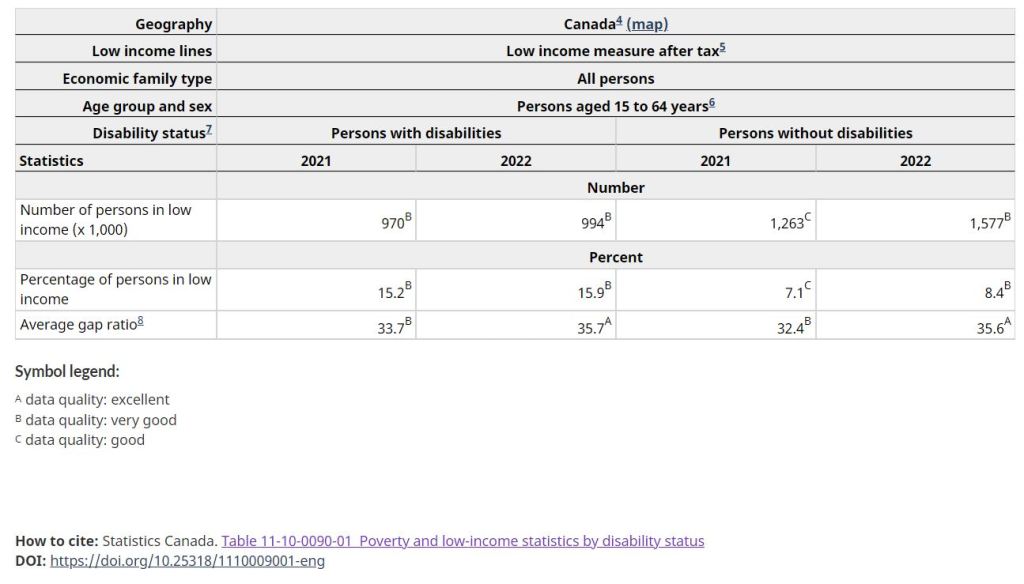
Persons living below the poverty line (Market Basket Measure, 2018 base), Canada, 2018 to 2022

According to the National Institute of Health on PubMed, https://www.ncbi.nlm.nih.gov/pmc/articles/PMC9836941/
“Exploring the role of discretionary income as a social determinant of health” is a study “… to explore the impact of discretionary income on the overall well‐being of Americans, …”at all income levels, those with discretionary income at the end of the month were 6–7 percentage points more likely to report better than average health than those with none, controlling for other factors”. This demonstrates a significant improvement in a group of people where any improvement in health is a huge benefit.
Ways the Government Can help without additional funding to Disability benefits
Employment:
There was little consideration to this from the Canadian Government in regards to the proposed regulation for the CDB, none mentioned. It needs more attention because the impact of the government using federal funds for employment to keep people with disabilities from needing federal benefits in the first place is quite substantial.
For example, I worked as a caregiver for a palliative young boy. For 15 years he needed 24 hr care which did not necessarily need to be completed by us in 8-hour shifts. 4 or 5 full-time caregivers were employed which could have been people with various physical disabilities filling. How much money could this save taxpayers? Applied across the entire caregiving industry alone it could be in the Billions!! How much better will people with disabilities feel about life and their health if they can have some degree of financial independence through this.?
I have followed the postings for the Government at
and there are zero jobs in over two thousand postings suitable for workers with disabilities from home or remote workers with disabilities. We do not need full jobs so why not rethink employment? How many roles within the RCMP organization can have tasks parsed out to lower wage earners for example? Typical Roles are designed around 9-5 types of routine work, but many parts of many roles can be done remotely from home and on our own time. There are tasks we can be trained to specialize in too.
Part of the problem is trying to fit disabilities into working roles instead of finding tasks that fit the disability of the individual. I am sure some of us can function as assistants for research, communication, coaches, editors, summarizing info, etc.
Here is a bit of a detailed look into this concept.
Strategies to Increase Remote Work Opportunities for people with disabilities in Government Roles
Governments can adopt strategies to make remote work more accessible and inclusive for employees with disabilities, allowing them to contribute effectively to government tasks and roles from home. This should set as an example to large corporate employers to how they can reconsider roles within their organizations so that they fit the disabilities of the individuals rather than appealing only to a predefined typical role:
- Policy Development and Support
- Develop policies that support remote work as a viable option for employees with disabilities. Ensure these policies are flexible and inclusive, accommodating various disabilities that may require non-traditional work arrangements.
- Encourage government departments to prioritize remote work opportunities for individuals with disabilities, where feasible, as part of their broader diversity and inclusion initiatives.
- Technological Accessibility
- Invest in accessible technology that supports remote work, including software with built-in accessibility features, assistive technologies, and adaptive hardware tailored to different disabilities.
- Ensure all digital platforms, including collaboration and communication tools used in government roles, are accessible by default to minimize the need for individual accommodations. I am sure this is already possible.?
- Training and Awareness
- Conduct training programs for HR departments and managers to increase awareness of the benefits of hiring individuals with disabilities for remote roles and managing inclusive remote teams. The benefit to Canada to have motivated, contributing, happy members of a previously excluded group that now requires less funding. More government funded jobs should have training available for people with disabilities.
- Promote understanding of the unique challenges faced by employees and the importance of remote work as an accommodation option, shifting perceptions about their capabilities and contributions.
- Provide specific grants for upgrading skills to qualify for remote work.
- Flexible Work Arrangements
- Offer flexible work hours and part-time options to accommodate the varying needs of employees. This flexibility can help employees manage health conditions, medical appointments, and energy levels more effectively.
- Encourage job-sharing, pairing remote and local employees as a duo or more as a team.
- Inclusive Recruitment Practices
- Simplify the recruitment process for remote roles, making it accessible for candidates. Consider direct hire programs or special recruitment drives that focus on remote opportunities for individuals. A “National Hire People with Disabilities Day”, or something less cheesy.
- Collaborate with disability organizations for job matching, training, and awareness initiatives, ensuring job descriptions explicitly mention remote work and flexible arrangements as options.
- Supportive Work Environments
- Create home office support packages that provide the necessary equipment, software, and accessible setups to ensure employees have a comfortable and efficient workspace.
- Establish clear channels for ongoing feedback from employees to refine and improve remote work policies and practices, ensuring they meet real-world needs and remain adaptive to changing circumstances.
- Incentives and Recognition
- Encourage government departments that successfully integrate remote work for employees by providing incentives, such as funding for technology upgrades or recognition awards for inclusive practices.
- Highlight success stories and best practices within government to promote a culture of inclusivity and accessibility across all departments.
- Public Awareness and Advocacy
- Use government platforms to advocate for the benefits of remote work for all, especially highlighting how it can empower individuals and enhance their participation in the workforce.
- Promote the narrative that a diverse and inclusive workforce, including those with disabilities, brings unique perspectives and valuable skills, benefiting both the government and society.
- Pilot Program
- Have trials across a few regions that are remote. Any remote jobs that I did see were restricted to a specific radius such as 100km from a major city like Toronto, Ottawa, or Edmonton. The remote jobs should apply to anyone legally entitled to work in Canada.
- People in the most remote areas could be given priority to demonstrate the efficacy if there is any.
By implementing these strategies, governments can create a more inclusive, flexible, and supportive work environment for individuals, maximizing their potential while fostering a diverse and skilled workforce. They can also reduce the number of people reliant on financial benefits such as the CDB and provincial programs.
In Conclusion
The enhancement of discretionary income for people with disabilities is a sign of a society looking for true inclusivity. It’s a big step towards not only alleviating individual hardships but also enriching the societal fabric through economic inclusion, diversity of wants, and integration into society in a more productive and active manner. There are more than 1 way to fund this and the CDB offers an opportunity to do so.
 TC 'ventures
Leave a word